Mistral has released a preview of ML4, internally nicknamed “Le Chonk.” Yes, that is actually what they call it. The model has 1 trillion parameters, although only 49 billion are active at a time. Mistral developed the model in France and says it outperforms other open-weight models developed in the US and Europe. The company plans to release the weights on October 27.
How Mistral Built ML4
Mistral built ML4 from the ground up in roughly two months using 3,800 NVIDIA Grace Blackwell GPUs across its own European data centers. The 1-trillion-parameter model uses a mixture-of-experts architecture with 49 billion parameters active at a time. It is also natively multimodal and supports more than 160 languages, including every official language of the European Union.
Mistral decided to show the model before training is completely finished. The company says it is still completing the final reinforcement-learning stage and expects to wrap it up within days. That makes this more of a late-stage preview than a completely finished release.
One area Mistral is putting a lot of attention on is cybersecurity. We have already seen how far models can go here with Anthropic’s Claude Mythos, which showed unusually strong capabilities in vulnerability research and other security tasks.
During the ML4 launch, chief scientist Guillaume Lample said Mistral is approaching the same problem from the defensive side, with ML4 aimed at helping companies and governments respond to attackers using powerful AI models as part of cyberattacks.
Cybersecurity is only one part of the model’s focus. Mistral is also targeting coding, finance, manufacturing, visual grounding, geospatial work, and semiconductor-related tasks.
What the Early Benchmarks Show
Mistral has also published some early benchmark results for ML4. The company says the model performs competitively with some of the strongest open-weight models across coding and agentic tasks, while cybersecurity and visual grounding appear to be some of its stronger areas.
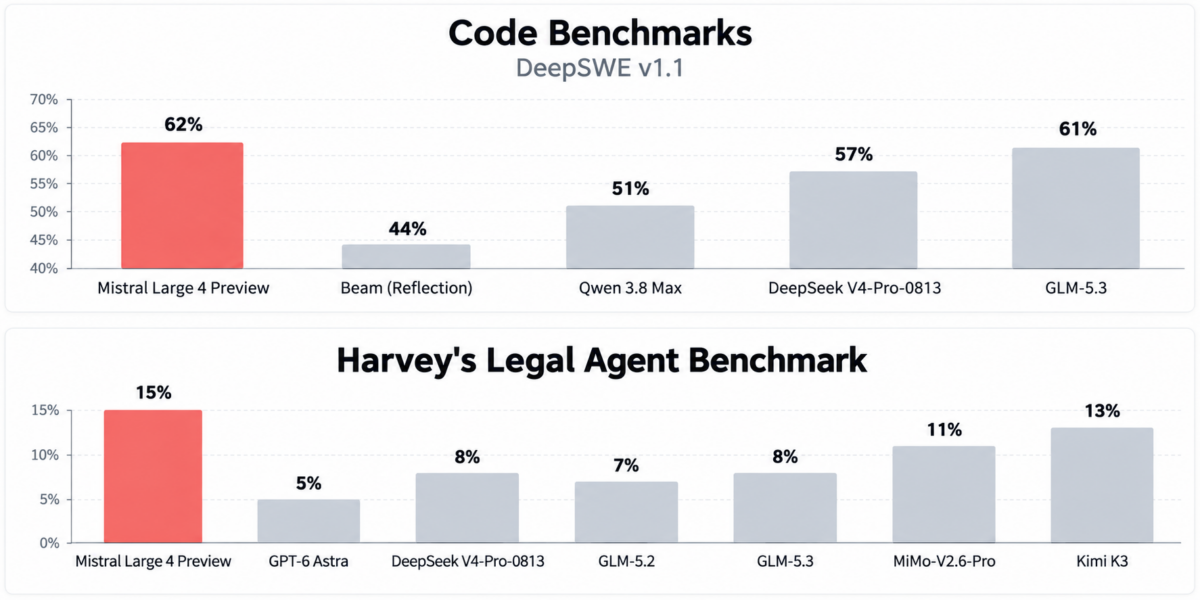
ML4 scores 62% on DeepSWE v1.1, putting it just ahead of GLM-5.3 at 61%. DeepSeek V4 Pro follows at 57%, while Qwen 3.8 Max and Reflection Beam sit lower at 51% and 44%.
On Harvey’s Legal Agent Benchmark, ML4 scores 15%, ahead of Kimi K3 at 13% and MiMo V2.6 Pro at 11%. The rest of the models in Mistral’s comparison land below 10%.
Compared with today’s biggest closed models, ML4 does not look like the go-to model yet, especially for coding, but the early results are still pretty strong. These benchmarks are preliminary, though, and different setups can change the scores quite a bit. The final model is also still being completed, so the real test will come after October 27, when the weights are public and researchers can see how well ML4 performs outside Mistral’s own evaluation setup.
The Main Focus Is Sovereignty
Many of today’s biggest open-weight models come from China, while several major AI labs in the US keep their most capable models closed. Mistral sees an opening in that gap, especially among European governments and companies that want to run AI on their own infrastructure.
The idea is not limited to Europe either. Running open weights gives organizations more control over where the model runs, what happens to their data, and whether they need to depend on continued access to another company’s API.
Companies in regulated industries, government, or defense may consider ML4 a more practical European open-weight alternative if compliance requirements prevent them from using models such as DeepSeek or Kimi.
What You Can Do With ML4 Right Now
Developers and researchers can already access the ML4 preview through Mistral’s API in Mistral Studio. Mistral is also working with cybersecurity teams and government organizations before the open-weight release so they can test the model in real-world environments.
Anyone interested in running ML4 on their own hardware will need to wait until October 27. We know the model has 1 trillion parameters with 49 billion active at a time, but Mistral has not shared enough architecture and deployment details yet to say exactly what kind of hardware the open weights will require.
And with a trillion parameters in total, this probably will not be the kind of model most people casually load onto a single gaming GPU. We will have a much better idea once the weights, formats, and likely quantized versions start showing up.